
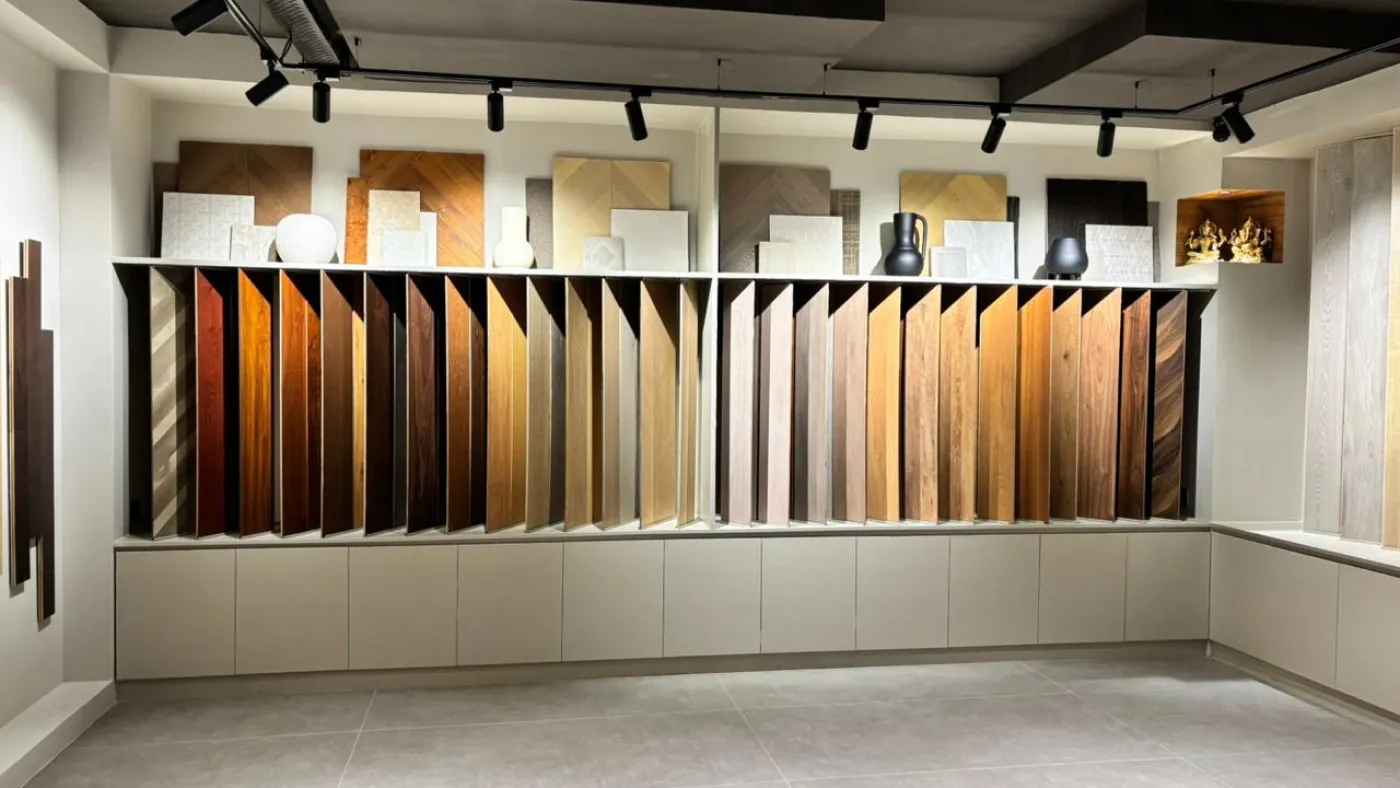
Walk into any showroom that is four years old and you can read its budget from the doorway.
Not from the design — from the wear. The entrance floor is dulled in a two-metre arc. The display lighting has drifted into three different shades of white. One counter edge is chipped where every customer leans. The concept was fine. The specification was not.
Retail interiors are judged on opening day and paid for over five years. The gap between those two facts is where the money goes.
What makes a showroom fit-out last?
Specifying for footfall and maintenance rather than for photographs. The decisions that decide how a showroom looks in year three are the floor build-up at the entrance, the lighting specification, the edge details on anything customers touch, and whether the layout can be changed without rebuilding it.
None of those are visible in a rendering, which is why they lose arguments at budget stage. The renders show finishes and mood; the cost of a hard-wearing entrance zone or a properly specified lighting scheme looks like a line item that can be trimmed. It can — and the saving reappears as a refurbishment two years early, or as a floor that photographs badly in every piece of marketing you shoot afterwards. The useful discipline is to ask of every specification decision: what does this look like after a hundred thousand people have walked on it, leaned on it or moved it?
The entrance is a different building from the rest of the shop
The first few metres take grit, water in the monsoon, trolley wheels and every single visitor. The back corner takes almost none of that.
Specifying one floor across both is either overspending on the back or underspecifying the front — usually the second. What the entrance zone actually needs is a wear-resistant surface, slip resistance when wet, and a matting arrangement that takes grit off shoes before it becomes an abrasive on your good floor.
Entrance matting is the cheapest floor protection in retail and the most frequently deleted. It exists to stop the rest of the floor being sanded by the street.
Lighting is the specification that ages worst
Retail lighting fails in three ways, and only one of them is about brightness.
| Failure | What it does to the product |
|---|---|
| Colour rendering too low | Fabric, wood, stone and skin tones look wrong. Customers cannot say why, and do not buy |
| Mixed colour temperature | Replacements over the years drift. The room reads as patched rather than designed |
| Flat, even light everywhere | Nothing stands out. A showroom needs contrast between product and background, not uniformity |
Two practical protections. Record the exact lamp specification — colour temperature, colour rendering, beam angle, model — and hand it to whoever maintains the space, because the drift starts with the first casual replacement. And specify track or a flexible mounting system rather than fixing every light permanently, so the lighting can follow the merchandising when the layout changes.
The numbers to put in the specification
“Good lighting” is not a specification. These are the parameters a lighting supplier can actually be held to, and the ones worth writing into a tender.
| Parameter | What to ask for |
|---|---|
| Colour rendering (CRI) | CRI 90 or above where colour matters — textiles, colour-sensitive product, food |
| Colour temperature (CCT) | Roughly 2700–3000K for a warmer, high-end feel; 3000–4000K for general retail |
| Colour fidelity | Where colour is critical, ask for TM-30 Rf/Rg figures, not CRI alone |
| Illuminance by zone | Set against a recognised standard rather than a supplier’s own claim — EN 12464-1 and CIBSE guidance are the usual references |
| Beam angle | Specified per display type, because this is what creates contrast between product and background |
| Emergency lighting | Maintained levels on escape routes — a statutory item, not a design choice |
Two of these are worth insisting on even when budget is tight. CRI 90+ is the difference between a fabric looking like itself and looking slightly wrong in a way customers cannot articulate. And recording the exact specification — CRI, CCT, beam angle, model — is what stops the colour drift described above, because the drift begins with the first casual replacement by someone who was never told what was originally fitted.
Parameter guidance drawn from specifier-facing retail lighting practice, which points to EN 12464-1 and CIBSE for the numerical standards. Confirm the applicable standard and statutory requirements for your location before specifying.
Design for the layout change you know is coming
Retail layouts move. Ranges change, seasons change, the business changes. A showroom built as a single fixed composition has to be partly demolished to be rearranged.
The things that make change cheap are unglamorous and decided early: power and data brought to more positions than you currently need · lighting on track · display systems that unbolt rather than units built into the wall · a floor that reads as continuous so a moved fixture does not leave a scar.
That last one is worth a sentence. Fixtures fixed into the floor leave holes and patches when they move. A floor specified in the knowledge that things will be moved is one of the quieter marks of a showroom designed by somebody who has been back to one a few years later.
The details customers physically touch
- Counter and display edges. People lean. The edge detail decides whether it chips
- Door hardware. Used thousands of times a month. Cheap handles announce themselves quickly
- Trial room fittings — hooks, mirrors, seating. Small items, constant use, and the first things to look tired
- Corners on circulation routes. Trolleys and bags find every one. Corner protection is cheaper than repainting quarterly
- Anything at knee height. It gets kicked. Plan for it
The pattern is the same one that runs through every part of a commercial interior: it is almost never the material that fails, it is the junction, the edge and the fixing.
Refitting while you trade
Most showroom projects are refits of a trading store, not new shells, which makes phasing the central question rather than a detail.
It is worth pricing properly. Phased work costs more in total — hoarding, repeated setup, restricted hours, a team that cannot spread out — but it protects revenue. Whether that trade is worth it comes down to the same number as every other fit-out decision: what a closed day costs you.
For a trading showroom, phasing is frequently worth it. For a unit not yet open, it almost never is.
When we are not the right fit
If what you want is the cheapest refresh that photographs well for a launch, we are not that contractor. Specifying for wear costs more up front, and it shows in the quote.
Where we fit is an operator who intends to still be in the space in five years and would rather not refurbish it in three.
Questions retailers ask
What flooring lasts in a high-footfall showroom?
Less a product question than a zone question. Entrance, main circulation and back-of-house have different demands, and a matting arrangement at the door protects everything behind it.
How often should a showroom be refitted?
That depends on how it was specified. A showroom built to be rearranged — track lighting, unbolting displays, generous power — can be refreshed repeatedly without a full refit.
Can we stay open during the work?
Often, in phases. It costs more and takes longer overall, and for a trading store it is usually still the right answer.
Why does our lighting look uneven now?
Almost always mixed colour temperature from replacements over time. Record the original specification and give it to whoever maintains the space.
What should we decide before design?
Footfall pattern, what changes seasonally, what your building’s services can actually give you, and what the lease allows. All four shape the design more than the brief does.
Where to go next
Send us the space and how you trade in it. We will tell you where the wear will land, what the lighting has to do for your product, and what it takes to keep the layout changeable.
Talk to our team, or see the sectors we work in — showrooms, gyms, bars and offices.