

A shutter that stays down does not stop costing you money. Rent runs, salaries run, and the launch you booked advertising for moves. For most owners the real price of a fit-out is not the contract sum. It is the weeks the space earns nothing.
So the first question is usually how long does a commercial fit out take. The honest answer is that no credible published figure covers Indian commercial work across showrooms, gyms, bars and offices, and anyone quoting you a single number for all of them is guessing. What can be answered precisely is which parts of the programme are fixed, which are set by procurement, and which are genuinely in your control. That is the part worth understanding, because it is the only part you can act on.
This piece sets out the three clocks that decide your opening date, and how to sequence work so trading resumes sooner. If you want the cost side of the same decisions, we cover that separately in our guide to office interior cost in Hyderabad.
How long does a commercial fit out take?
There is no single reliable duration, and treating one as a promise is how programmes fail. Your date is set by three separate clocks running at once: statutory approvals, materials on order, and decisions still open. The slowest of the three sets your opening, not the average of them.
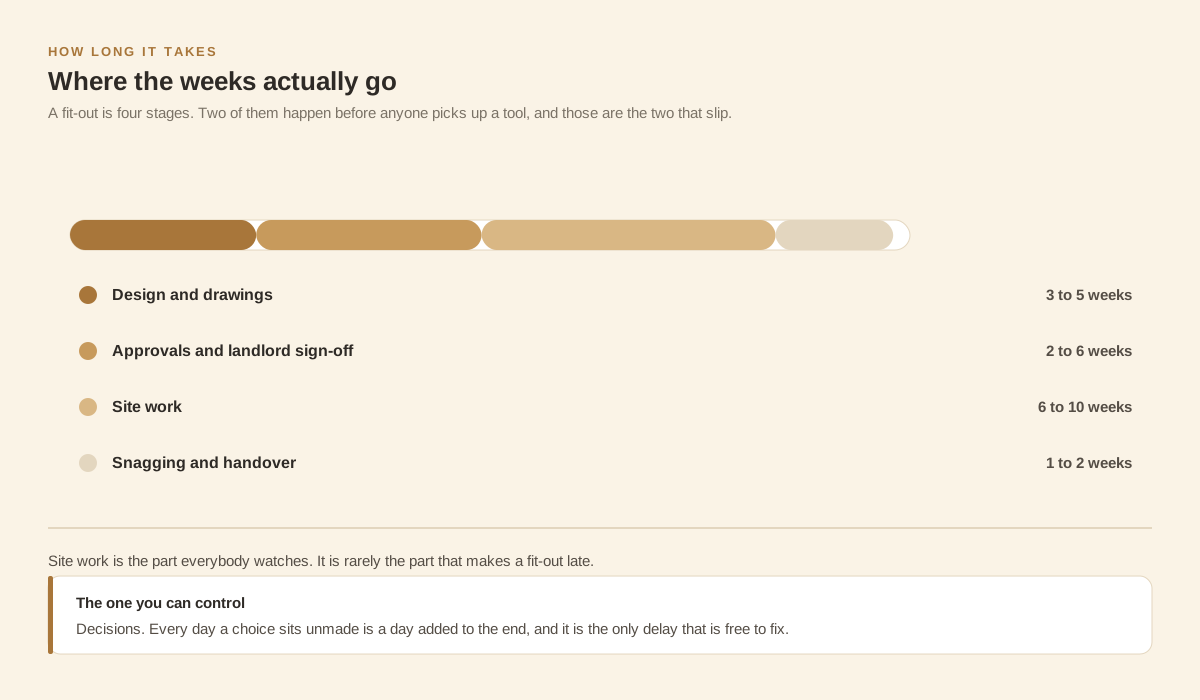
Most delay conversations go wrong because everyone talks about site work. Site work is rarely the constraint. A contractor can add labour to a partition or a ceiling and move faster. Nobody can add labour to a fire department review, and nobody can make a factory build a switchboard sooner by paying for more site staff. Those two clocks run whether or not anyone is on site, which is why they must start first. The third clock, open decisions, is the one owners underestimate most. Every unmade choice about a finish, a light fitting or a layout eventually stops something, and it usually stops it at the worst moment, once trades are mobilised and waiting. A programme is therefore not a list of activities in order. It is a plan for starting the slow things early enough that the fast things are never held up. Get that right and the fit-out feels quick. Get it wrong and it feels endless even when the site team is working well.
The useful question is not how many weeks. It is which of my three clocks has not started yet. That is answerable today, on your own project, without anyone quoting you an average.
What is genuinely fixed, and what is not
Some parts of a fit-out cannot be compressed at any price. Statutory review takes the time the department takes. Concrete and screed need their days regardless of urgency. Manufactured items take as long as the factory takes. Everything else, which is most of the visible work, responds to money, labour and management.
Separating these three categories is the single most useful thing an owner can do before committing to an opening date. Once you know what is immovable, you can plan the rest around it instead of discovering the constraint halfway through. It also changes how you negotiate. Asking a contractor to compress work that is fixed by statute or by material behaviour is asking them to either lie to you or cut a corner that shows up later as a leak, a failed floor or a refused certificate. Asking them to compress work that is genuinely variable is a fair and answerable request, and a good firm will tell you what it costs in extra labour, extra shifts or a different specification. The table below is how we split a programme at the start, and it is worth building your own version before you sign anything.
| Programme item | Category | What it depends on |
|---|---|---|
| Fire no objection certificate review | Fixed by statute | Building height and occupancy; a complete drawing set at submission |
| Trade licence and fire safety certificate | Fixed by statute | Fire equipment in place; proof of occupancy |
| Concrete and screed curing | Fixed by physics | Cement type, weather and what goes on top of it |
| Paint, adhesive and finish drying | Fixed by physics | Ambient conditions and ventilation on site |
| Cooling plant, switchboards, lifts and specialist joinery | Fixed by procurement | Order date, not start date; factory queue and transport |
| Imported stone, tiles and light fittings | Fixed by procurement | Shipping and clearance; confirmed selection before ordering |
| Demolition, partitions, ceilings, first fix | Variable | Labour, shifts and access hours the landlord permits |
| Second fix, snagging and commissioning | Variable | Whether earlier work was done in the right order |
| Design decisions and drawing coordination | Variable, and yours | How quickly you approve and stop revisiting |
The approvals clock you cannot compress
Statutory review runs to the department’s timetable, not yours. In Telangana the fire process is staged and the timeline is published, which means it can be planned around precisely. The mistake is not the length of the review. It is submitting late, or submitting an incomplete drawing set that restarts the clock.
Telangana State Disaster Response and Fire Services sets out a defined process for the provisional and occupancy no objection certificate, running from online application through committee inspection and regional review to a decision by the Director General. Crucially, the Fire Services Department publishes its own processing times: seven days for premises under 15 metres, and fourteen days for those above 15 metres. That threshold is not arbitrary. The National Building Code of India, in its fire and life safety provisions, defines a high rise building as one 15 m or above in height, irrespective of its occupancy, so the height of the building you have chosen decides both the regime you fall under and the review time you should plan for. The same department lists the drawings required at submission, including site plan, basement and ground floor plans, floor-wise plans, terrace plan, section and elevation. An incomplete set is the most avoidable delay on any commercial programme.
Licensing carries its own dependency. Greater Hyderabad Municipal Corporation describes a trade licence as one issued by the local authority to run a listed business within its jurisdiction, with proof of occupancy required. Telangana Today, reporting rules from the corporation’s enforcement and disaster management directorate, says commercial establishments are expected to hold two fire extinguishers and two smoke detectors for every 100 square metres of plinth area, and that a trade licence will not be renewed without the fire safety certificate in place. For a bar or pub in particular, where trading is licensed and public occupancy is high, these are not paperwork at the end. They are dates that belong at the front of the programme.
The drying and curing nobody can pay to speed up
Where a fit-out involves concrete, screed or wet trades, the material sets the pace. Curing and drying are chemical processes running on their own schedule. Covering damp work early to save a week is the most expensive shortcut in commercial interiors, because the failure appears months later under a finished floor.
The Indian Standard IS 456 governs this, and the Public Works Department handbook published by the Water Resources Department of Maharashtra, which follows it, states plainly that the curing period should not be less than seven days, that curing may extend from fourteen to twenty-eight days for satisfactory strength development, and that the first seventy-two hours are the most critical. Those are not padding a contractor added to a bar chart. They are the conditions under which the material reaches the strength it was specified for. The same logic applies through the wet trades that follow. Levelling compounds, adhesives, waterproofing and paint each need their stated time before the next layer goes on, and every one of them is easier to rush than to remedy. A floor laid on a slab that has not given up its moisture will lift, cup or debond, and by then the shop is trading and putting it right means closing again.
The practical answer is not to fight it but to schedule around it. Wet work goes early, in parallel with procurement and approvals, so the drying time is spent while other clocks are still running rather than at the end when everyone is waiting.
Procurement usually sets your date, not labour
The item that opens your doors late is rarely a wall. It is a piece of equipment or a made-to-order element ordered after design was finalised rather than before. Long lead items should be selected, approved and ordered while drawings are still being coordinated, not once site work begins.
There is no authoritative Indian published table of lead times for cooling plant, switchboards, lifts, imported stone or specialist joinery, and any article presenting one as fact is inventing it. Lead times move with the manufacturer, the specification, the season and the supply chain of the moment, which is exactly why they must be confirmed on your project rather than assumed from a guide. What is consistent is the pattern of failure. Independent accounts of stalled retail and commercial projects repeatedly identify the same causes: site measurements that did not match the drawings, materials specified that were not available locally, electrical layouts that conflicted with actual building conditions, and imported finishes chosen without checking how long they take to arrive. Every one of those is a procurement or coordination failure disguised as a construction delay. None of them are fixed by pushing the site team harder.
The discipline that works is unglamorous. Identify the five slowest items on your project in the first week, confirm their real lead time in writing from the supplier, and order them before the decorative decisions are settled. We describe how that sits inside a full programme in our piece on how a turnkey commercial interior runs from brief to handover.
Bring us the space and the brief. We will tell you honestly what it needs and what it does not.
Sequencing so you resume trading sooner
Downtime shortens when slow things start early and decisions stop moving. Overlapping approvals, procurement and wet trades at the front of a programme, then locking the specification, does more for your opening date than any amount of extra labour at the end. The last four weeks are where poor sequencing becomes visible.
The pattern we see repeatedly is a project that looks comfortable for two thirds of its life and then collapses into a scramble. That happens when approvals were submitted late, long lead items were ordered after design sign-off, and a handful of finishes were still being debated while trades waited. Published accounts of exactly this describe a project stretching from roughly forty-five to seventy-five days, where the operator paid an extra month of rent without revenue and salaries without operations. The contract sum did not move. The cost to the business did. Sequencing is what prevents that, and it is decided in the first fortnight, not the last. It is also the reason a fit-out where design and execution sit under one contract tends to hold its date better: the person coordinating drawings and the person ordering materials are answerable to the same programme, so a decision that affects procurement is caught the day it is made.
| Lever | What it protects | When you must decide |
|---|---|---|
| Measured survey before design is frozen | Prevents rework when site does not match landlord drawings | Before design starts |
| Fire submission with a complete drawing set | Avoids a restarted statutory review | First two weeks |
| Long lead items ordered early | Stops procurement becoming the final constraint | Before decorative sign-off |
| Wet trades scheduled at the front | Spends drying time while other clocks still run | At programme sign-off |
| Specification frozen in writing | Removes the pause that idles mobilised trades | Before site work begins |
| Phased handover of trading areas | Reopens part of the space while work continues | At design stage, if it is possible at all |
Phasing deserves a caution. It sounds attractive and often is not available. Dust, noise, fire compartmentation and safe public access all limit what can trade beside live work, and in a gym or a showroom the partial experience can do more brand damage than a clean closure. Ask whether it is genuinely possible before building a plan around it.
Hyderabad: what the building does to your programme
Location changes your timeline through building management, not distance. Managed towers in the technology corridor impose working hours, permits and lift bookings that lengthen a programme predictably. Older commercial stock in the established districts offers looser access but less predictable shells, which lengthens programmes unpredictably. Both are workable if planned for.
In Madhapur, HITEC City, Gachibowli, Kondapur and the Financial District, much of the commercial stock is recent and professionally managed. That helps: shells are consistent, service risers are planned, and the landlord fit-out guide is a real document. The cost is process. Noisy work may be restricted to nights or weekends, material movement needs booked lift slots, and every contractor needs permits and inductions before touching the floor. None of this is a problem when it is in the programme from day one, and all of it is a problem when it is discovered in week three. In Jubilee Hills and Banjara Hills, where a good deal of showroom and hospitality space sits in converted or older buildings, access is often easier but the shell is less predictable. Slabs may need levelling, existing services may need replacing, and the make-good works nobody priced become the works that push the date. The survey is what tells you which situation you are in.
Our own commercial work spans these conditions, including a TOSTEM office fit-out in Rajahmundry and a Floors 2 Decor showroom in Hyderabad. You can see the range on our commercial projects page.
When we are not the right fit
We deliver turnkey commercial interiors across showrooms, gyms, bars and office spaces in Hyderabad, with design and execution under one contract. That structure exists mainly to protect the programme, because it removes the gap between the person drawing and the person buying.
It is not right for everyone. If you want a contractor to build drawings your own architect has already completed, a pure execution firm suits you better. If your project is residential, we do not do that work. If you need someone to promise a fixed opening date before a survey and before approvals have been scoped, we will not give you that number, and any firm that does is guessing with your rent. And if your requirement is a single small refresh, a specialist trade contractor will be quicker than a full turnkey process.
If a commercial fit-out with a programme you can rely on is what you need, talk to our team about your space and your opening date.
What are the stages of a commercial fit-out?
Broadly: survey and brief, design and drawing coordination, statutory submissions, procurement of long lead items, demolition and make-good, first fix services, ceilings and partitions, flooring and wet trades, joinery and second fix, finishes, commissioning, snagging and handover. The order matters more than the list, because approvals and procurement must start before site work.
What causes most fit-out delays?
Late statutory submission, long lead items ordered after design sign-off, and decisions left open while trades wait. Site measurements not matching landlord drawings and services that cannot carry the intended load are close behind. Very little of it originates with the site team.
How long does a fire NOC take in Telangana?
Telangana State Disaster Response and Fire Services publishes processing times of seven days for premises under 15 metres and fourteen days for those above 15 metres, following an online application, committee inspection and regional review. Submitting an incomplete drawing set is what turns a short review into a long one.
Can I keep trading during a fit-out?
Sometimes, and it must be assessed honestly rather than assumed. Dust, noise, fire compartmentation and safe public separation all limit it. Where phasing genuinely works it reduces downtime substantially. Where it does not, a shorter clean closure usually costs the business less than a long compromised one.
Can I pay to make a fit-out faster?
You can compress the variable work with extra shifts, more labour and closer supervision, and it costs money. You cannot compress statutory review, curing and drying times, or a factory queue. Money spent trying to shorten those buys a defect rather than a date.
What happens to the programme if something is discovered late?
It depends what it is and what the contract says. Base building defects and services capacity shortfalls are the two most common late discoveries, and both take time as well as money to resolve. A measured survey and a services check before design is frozen is the only reliable way to stop them appearing after mobilisation.
Why do wet trades need so long?
Because curing and drying are chemical, not a matter of effort. The Public Works Department handbook following IS 456 states the curing period should not be less than seven days, that it may extend from fourteen to twenty-eight days for satisfactory strength development, and that the first seventy-two hours are the most critical. Covering damp work early causes failures under finished floors.
How do I hold a contractor to the date?
Agree a programme with named milestones for approvals, procurement orders and specification freeze, not just a completion date. Ask for written confirmation when each long lead item is actually ordered. A date without milestones is a hope, and it is usually the client’s own late decisions that break it first.
Telangana State Disaster Response and Fire Services, provisional and occupancy fire NOC — process stages, required drawings, and processing times of 7 days under 15 metres and 14 days above.
National Building Code of India 2016, Part 4 Fire and Life Safety — high rise defined as 15 m or above, irrespective of occupancy.
Public Works Department handbook on placement of concrete, following IS 456 — curing not less than 7 days, extending 14 to 28 days, first 72 hours most critical.
Greater Hyderabad Municipal Corporation, trade licence — definition and documents required.
Telangana Today on new fire rules for commercial establishments — fire equipment per 100 square metres of plinth area, and trade licence renewal.
UODC Architects on why store fit-outs run late — measurement, availability and coordination failures, and a project stretching from 45 to 75 days.
Zentura on hidden fit-out costs — variations after signing and existing services capacity as the most common causes of overrun.